Article: What Is a Banarasi Saree? A Guide to India’s Iconic Silk Weaving Tradition

What Is a Banarasi Saree? A Guide to India’s Iconic Silk Weaving Tradition
A Banarasi saree is one of India's most recognisable expressions of textile craftsmanship, celebrated for its luxurious fabric, intricate weaving, elaborate motifs, and rich cultural heritage. Originating in Varanasi, traditionally known as Banaras, these sarees have long been associated with Indian weddings, festive dressing, and grand celebrations.
Known for their lustrous appearance and detailed woven patterns, Banarasi sarees have evolved from traditional ceremonial attire into an enduring part of contemporary Indian fashion. Their distinctive use of brocade techniques, intricate motifs, and elaborate borders allows designers to reinterpret the classic saree in increasingly modern ways.
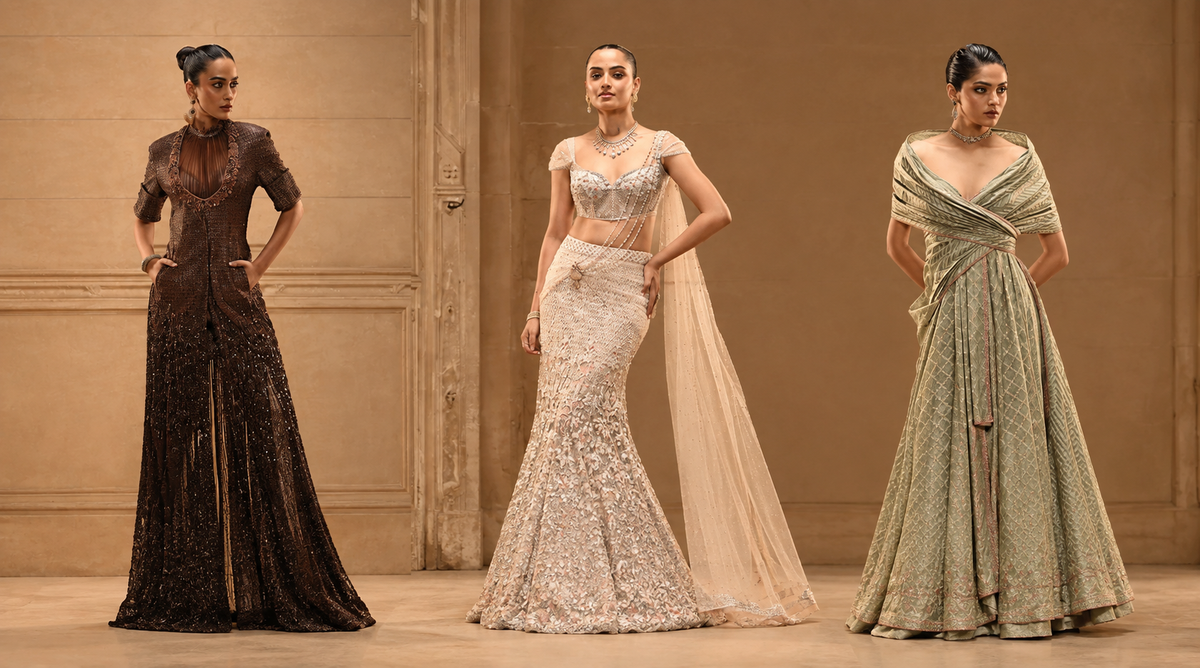
Today, the Banarasi aesthetic extends beyond a single silhouette or styling tradition. Designers such as Tarun Tahiliani bring the richness of Indian textile heritage into contemporary occasionwear through brocade, embroidery, embellishment, sculptural draping, and modern blouse designs. The result is a dialogue between India's traditional weaving vocabulary and the possibilities of modern fashion.
What Is a Banarasi Saree?
A Banarasi saree is a traditional Indian saree associated with Varanasi, Uttar Pradesh. It is particularly recognised for its luxurious fabric and intricate woven designs, often featuring motifs inspired by nature, architecture, florals, and traditional Indian art.
The term "Banarasi" describes the saree's regional and textile heritage rather than one single design. Banarasi sarees can vary considerably in colour, motifs, weaving techniques, borders, and surface detailing.
One of their defining characteristics is the use of brocade weaving, which creates richly patterned surfaces and gives the saree its distinctive visual depth.
Where Did Banarasi Sarees Originate?
Banarasi sarees originate from Varanasi, one of India's historic cultural and artistic centres. The city has developed a strong reputation for silk weaving and textile craftsmanship over centuries.
The weaving tradition became particularly associated with richly patterned silk and brocade textiles. Skilled artisans developed intricate techniques for creating elaborate motifs and borders, contributing to the distinctive identity of Banarasi textiles.
Over time, Banarasi sarees became an important part of Indian ceremonial dressing, particularly for weddings and significant festive occasions.
Their cultural importance continues today, with the Banarasi weaving tradition inspiring both traditional weavers and contemporary designers.
What Makes a Banarasi Saree Special?
Several characteristics distinguish a Banarasi saree from other Indian saree traditions.
Rich Textile Heritage
Banarasi sarees are deeply connected to India's long history of silk and brocade weaving. The craftsmanship involved in creating detailed woven patterns gives the textile its distinctive character.
Intricate Motifs
Traditional Banarasi textiles are known for elaborate motifs. Floral patterns, paisleys, foliage, geometric arrangements, and traditional jaal designs are among the visual elements commonly associated with the aesthetic.
Brocade Craftsmanship
Brocade is central to the Banarasi visual language. Patterns are created through intricate weaving techniques, resulting in a richly textured and detailed surface.
Lustrous Appearance
Silk Banarasi sarees are recognised for their characteristic sheen. Depending on the weave and design, the fabric can create a striking interplay of light across the body, border, and pallu.
Statement Borders
Borders are often an important design feature. They can introduce contrast, elaborate motifs, metallic detailing, or intricate patterns, creating definition within the overall saree.
What Is Brocade and How Is It Related to Banarasi Sarees?

Brocade refers to a decorative textile technique in which additional threads are used to create elaborate patterns on the surface of the fabric.
Banarasi textiles are strongly associated with brocade weaving, although not every brocade saree is necessarily a traditional Banarasi saree.
This distinction is useful when exploring contemporary Indian fashion. Designers can draw from the visual language of Banarasi weaving and brocade while introducing embroidery, crystals, sequins, beads, or other embellishments.
For example, the Quintessence Crystal Detailed Brocade Saree by Tarun Tahiliani takes the richness of brocade and introduces a crystal border, paired with a complementing blouse.
The approach demonstrates how a traditional textile vocabulary can be adapted for contemporary occasionwear without losing its sense of richness.
What Are the Common Motifs Found in Banarasi Sarees?
Banarasi textiles are known for an extensive vocabulary of motifs, many of which draw from nature and traditional Indian visual culture.
Floral Motifs
Floral patterns are among the most recognisable elements in Banarasi design. They can appear individually or as part of larger repeating arrangements.
Jaal Patterns

A jaal is a network-like arrangement in which motifs are distributed across the fabric to create an interconnected pattern.
Tarun Tahiliani's approach to brocade incorporates this vocabulary through signature jaal motifs. The Brocade Saree Blouse Fabric features TT signature jaal motifs, an intricately hand-embroidered border, and matching blouse fabric.
Nature-Inspired Motifs
Leaves, flowers, vines, and other botanical forms have long been part of India's textile design vocabulary. These motifs can be woven or interpreted through contemporary embroidery and embellishment.
Traditional Decorative Forms
Banarasi-inspired textiles can also incorporate paisleys, geometric arrangements, architectural references, and other decorative forms, depending on the design tradition.
Banarasi Sarees and Contemporary Designer Fashion

The enduring relevance of the Banarasi saree lies partly in its ability to adapt.
Contemporary designers are exploring the textile through new proportions, embellishments, blouse silhouettes, and draping techniques. Instead of treating heritage textiles as fixed forms, modern fashion allows them to become foundations for experimentation.
This approach is visible in Tarun Tahiliani's brocade and saree designs, where traditional textile references are combined with intricate surface detailing and contemporary construction.
The Quintessence Crystal and Kundan Embellished Banarasi Saree combines a Banarasi saree with crystal detailing, hand-embroidered sequin and Kundan borders, and a complementing embroidered blouse.
Here, the traditional richness of Banarasi is enhanced through surface embellishment, creating a look suited to contemporary celebrations and formal occasions.
What Are Different Types of Banarasi Sarees?
Banarasi sarees can be differentiated by their weaving techniques, motifs, fabric, colour palette, and surface detailing.
Silk Banarasi Sarees
Silk Banarasi sarees are among the most widely recognised forms, valued for their lustrous appearance and rich drape. They are particularly popular for weddings, festive occasions, and formal celebrations.
Brocade Banarasi Sarees
Brocade Banarasi sarees emphasise elaborate woven motifs and patterned surfaces. They can feature rich borders, jaal designs, florals, and other intricate arrangements.
Embellished Banarasi Sarees
Modern designers may complement the traditional textile with crystals, sequins, beads, embroidery, or other surface embellishments. These interpretations are particularly suited to contemporary occasionwear.
Contemporary Banarasi-Inspired Sarees
Modern interpretations may retain the visual language of Banarasi textiles while experimenting with blouse construction, draping, embroidery, and silhouette.
This allows the heritage aesthetic to move beyond strictly traditional dressing.
How Is a Banarasi Saree Styled?
Styling a Banarasi saree depends on the occasion and the character of the textile.
For Weddings
A traditional Banarasi saree can be paired with statement jewellery, an embroidered blouse, traditional bangles, and a classic drape for a ceremonial look.
Gold jewellery works particularly well with richly woven textiles, while statement earrings or necklaces can provide a more contemporary interpretation.
For Festive Occasions
For festivals and family celebrations, consider balancing the richness of the saree with refined accessories. A detailed blouse and understated jewellery can create an elegant festive ensemble.
For Evening Events
Embellished Banarasi and brocade sarees can work beautifully for receptions and evening celebrations. Crystal borders, sequins, metallic embroidery, and statement blouses can shift the traditional textile towards contemporary eveningwear.
For a Modern Look
Experiment with the blouse. A structured blouse, sculptural silhouette, contemporary neckline, or unconventional layering can give a traditional Banarasi saree a more fashion-forward character.
How Tarun Tahiliani Reinterprets Brocade Sarees

Tarun Tahiliani's approach to Indian occasionwear frequently brings together traditional textile references and contemporary craftsmanship.
Brocade becomes a foundation for exploring embroidery, embellishment, motif, proportion, and surface texture.
The Brocade Saree Blouse Fabric inspired by the TT Design Studio's art piece Shikargah presents a handwoven brocade classic saree embellished with sequins, beads, and intricate hand embroidery, complemented by matching blouse fabric.
This demonstrate how the visual richness associated with traditional Indian textiles can be translated into a more elaborate contemporary occasionwear vocabulary.
When Should You Wear a Banarasi Saree?
A Banarasi saree can be appropriate for a wide range of occasions depending on its design and styling.
- Weddings: Choose richly woven or embellished styles with statement jewellery.
- Festivals: Opt for traditional motifs and a balanced styling approach.
- Wedding receptions: Consider contemporary blouses and embellished Banarasi designs.
- Formal celebrations: A refined brocade saree with sophisticated accessories can create an elegant look.
- Cultural occasions: Traditional Banarasi designs naturally complement the ceremonial character of the event.
The versatility of the textile means that the same heritage can be expressed through both traditional and contemporary styling.
How to Choose the Right Banarasi Saree
When choosing a Banarasi saree, consider the occasion, level of embellishment, colour, motif, and desired silhouette.
Consider the Occasion
A heavily embellished saree may be suited to a wedding reception or evening celebration, while a more traditional woven design can work beautifully for festive or daytime occasions.
Look at the Motifs
Motifs can significantly influence the character of the saree. Floral patterns can create a softer aesthetic, while structured jaal designs or elaborate borders can produce a more dramatic visual effect.
Balance the Blouse
The blouse can either complement the saree's traditional character or introduce a contemporary contrast. For heavily detailed sarees, a carefully coordinated blouse can create visual cohesion.
Consider the Embellishment
Crystals, sequins, beads, embroidery, and Kundan details can transform the character of a Banarasi saree. Consider the level of embellishment in relation to the event and the jewellery you intend to wear.
Why Is the Banarasi Saree Still Relevant Today?
The Banarasi saree remains relevant because its foundation is rooted in craftsmanship rather than a passing trend.
Its intricate motifs, luxurious appearance, and association with Indian textile heritage make it naturally suited to important occasions. At the same time, contemporary designers can reinterpret the textile through modern silhouettes, embroidery, embellishment, and styling.
This balance allows Banarasi sarees to move between generations. A traditional saree can carry cultural significance while a contemporary interpretation can feel distinctly current.
That combination of heritage and adaptability is what makes the Banarasi saree one of India's enduring textile traditions.
Frequently Asked Questions About Banarasi Sarees
What is a Banarasi saree?
A Banarasi saree is a traditional Indian saree associated with Varanasi, Uttar Pradesh, known for its rich textile heritage, intricate motifs, brocade weaving, elaborate borders, and luxurious appearance.
Why is a Banarasi saree famous?
Banarasi sarees are famous for their intricate weaving, rich silk and brocade textiles, distinctive motifs, elaborate borders, and long association with Indian weddings, festivals, and ceremonial dressing.
Is every brocade saree a Banarasi saree?
No. Brocade refers to a textile weaving technique, while Banarasi refers to a textile tradition associated with Varanasi. A Banarasi saree can feature brocade weaving, but not every brocade saree is necessarily a traditional Banarasi saree.
What motifs are commonly found on Banarasi sarees?
Common motifs include florals, leaves, vines, paisleys, jaal patterns, geometric arrangements, and other traditional decorative forms.
How can you style a Banarasi saree for a modern look?
A Banarasi saree can be styled with a contemporary blouse, statement earrings, refined jewellery, modern draping, or embellished accessories. Pre-draped and structured silhouettes can also create a more contemporary interpretation.
Are Banarasi sarees suitable for weddings?
Yes. Banarasi sarees are traditionally associated with weddings and other important celebrations. Richly woven silk, elaborate borders, traditional motifs, and statement styling make them particularly suited to ceremonial occasions.
Conclusion
A Banarasi saree represents much more than an elegant piece of Indian clothing. It is a reflection of India's rich weaving heritage, skilled craftsmanship, artistic vocabulary, and enduring relationship with textiles.
From intricate brocade patterns and traditional motifs to contemporary crystal embellishment, embroidery, and modern blouse silhouettes, the Banarasi aesthetic continues to evolve without losing its connection to heritage.
The work of contemporary designers such as Tarun Tahiliani demonstrates how this textile language can be interpreted for today's occasionwear. By combining traditional brocade influences with embroidery, embellishment, and considered construction, the Banarasi saree continues to occupy a distinctive place in modern Indian fashion.
Its ability to honour the past while adapting to the present is ultimately what makes the Banarasi saree an enduring icon of Indian textile tradition.